





 Share this article
Migration is not a phenomenon
unique to the 21st century.
While Georgians today often move to Europe in search of better opportunities
and living conditions, in the early 19th
century, the movement went in the opposite direction, with Europeans coming to
Georgia in search of a better life.
At the time, Georgia was part of the Russian Empire, and the settlement of
foreigners, encouraged by the Tsarist authorities, was primarily intended to strengthen Russification. At the same
time, the Russian Empire viewed these
settlers as a resource for economic growth, financing them more generously than
even the local Russian population.
This marked the beginning of German migration to Georgia.
Germans lived alongside
Georgians for more than a century, and left behind them a rich and
distinctive architectural heritage that can still be seen today in their former
settlements.
The
Soviet era largely erased the history of Georgia’s German population,
shrouding it in a sort of taboo. It is striking that this fascinating part
of Georgia’s modern history was absent from school and university curricula for
decades. It was only in 2015–2017 that, with the financial
support of the National Agency for Cultural Heritage Preservation of Georgia,
German settlements and their architectural heritage were documented,
scientifically studied, and researched.
Most of the Germans who settled in Georgia from 1817 onward were Swabian peasants from the villages of Württemberg. The first 31 families arrived in 1817 and were settled near the village of Sartichala. They named the settlement Marienfeld in honor of Empress Maria Feodorovna, mother of the Russian Emperor Alexander I and sister of King Frederick I of Württemberg.
In 1818, another large wave of German immigrants arrived in Georgia, leading to the establishment of several new settlements. By 1820, there were already six German colonies in Georgia: Marienfeld (the village of Sartichala), Neu-Tiflis (David Agmashenebeli Avenue and its surrounding streets), Alexanderdorf (present-day Tskaltubo and Samtredia streets in Tbilisi), Katharinenfeld (the town of Bolnisi), Elisabethtal (the village of Asureti), and Petersdorf (the village of Sartichala). Two more colonies, Helenendorf and Anenfeld, were located in present-day Azerbaijan. The migration of Germans continued in subsequent years. In 1842, the colony of Freudenthal was established near Abastumani; in 1848, it was relocated to the vicinity of Marienfeld and Petersdorf.
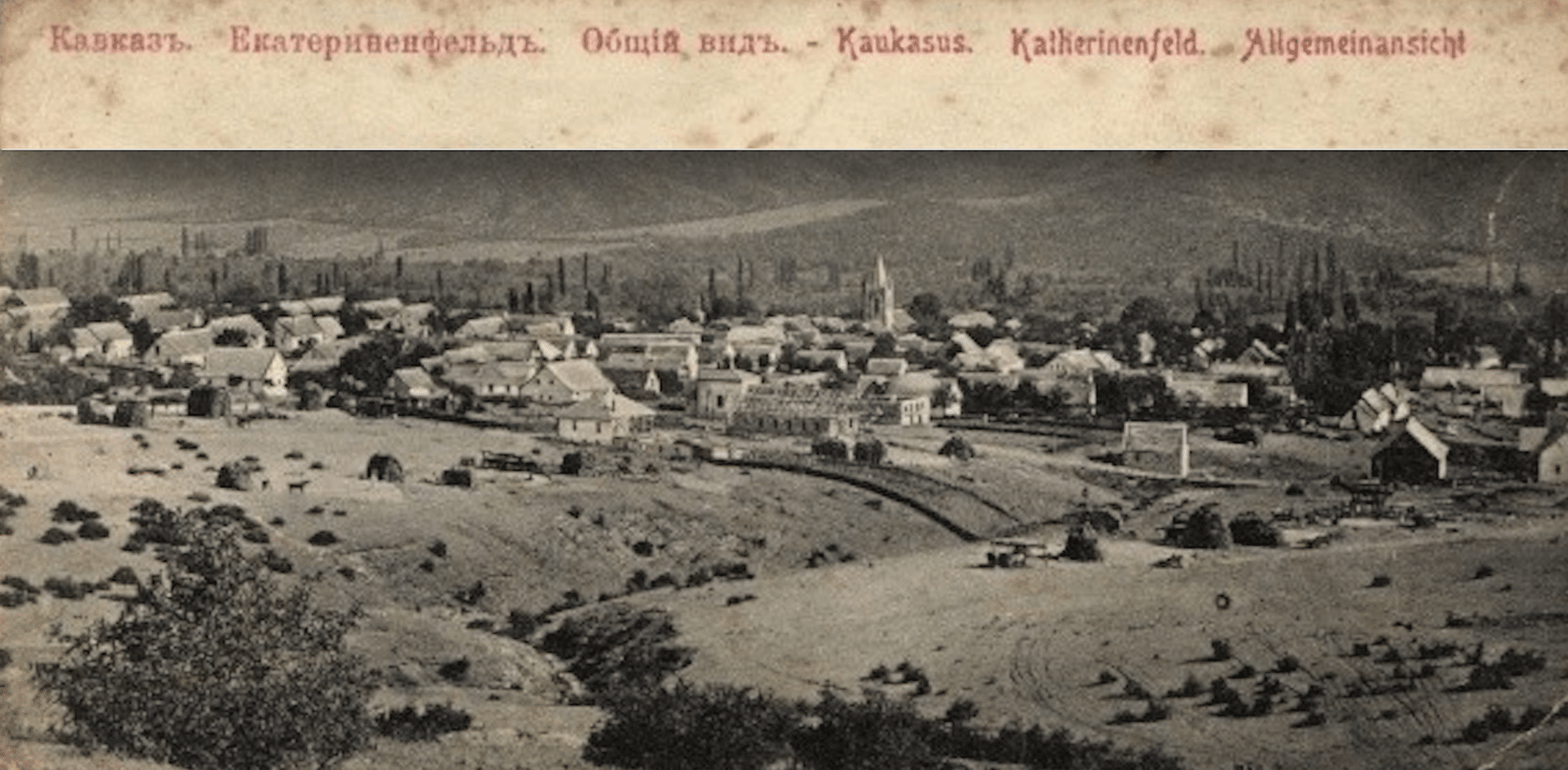
From the mid-19th century onward, population growth and economic prosperity within the German colonies led to the establishment of new settlements. In 1857, the colony of Alexandershilf (now the town of Trialeti) was founded for the landless residents of Elisabethtal. By 1891, the settlers of Alexandershilf had established the Petrovka colony near Kars and, later, in cooperation with the residents of Elisabethtal, founded the Blumental colony (the village of Kavta). At the outbreak of World War I in 1914, the Russian authorities relocated the colonists of Petrovka to the Eigenfeld colony established in 1906 in present-day Azerbaijan. With the assistance and support of the government, German settlements also emerged in Western Georgia, specifically in Abkhazia, between 1879 and 1884.
The economic prosperity of the
German settlers became increasingly evident from the 1850s onward. As the lands
initially granted by the authorities were no longer sufficient, financially
prosperous colonies, and at times, affluent individuals, began purchasing additional
plots from Georgian nobles using their own funds.
The establishment of German
colonies continued in the 20th century, resulting in the formation of new
settlements, including Traubenberg (the village of Tamarisi), Wiesendorf (the
village of Akhali Marabda), Steinfeld (the village of Kotishi), Waldheim (the
village of Ipnari), Marnauli (the town of Marneuli), Grünthal (the village of
Ruisbolo), Hoffnungstal (the village of Akhalsheni), Traubenthal (the village
of Ambartafa), and Rosenthal (the village of Vardisubani).
A new
settlement of German newcomers also emerged. In 1909, forty German families
from the Kuban region,
including three families from Samara, founded the colony of Georgstal near the village
of Mukhrani (present-day Dzveli Kanda).
The development of the German settlements was
closely tied to different branches of agriculture, determined primarily by the
location of the colonies and the local climate. Agriculture and wheat
cultivation were the main occupations in Alexandersdorf, Marienfeld,
Petersdorf, and Feuidental;
Katharinenfeld, Elisabethtal, and Traubenberg became known for viticulture,
winemaking, and fruit growing, while Alexandershilf and Waldheim specialized in
livestock breeding and the production of Swiss cheese.
Buildings constructed by the German settlers
for a variety
of functions have survived in
these villages to this day. Their residential architecture, however, deserves
particular attention, as vernacular architecture is one of the clearest
expressions of a society’s creative potential. Unlike urban houses designed and built by professional
architects or civil engineers, which quickly reflect prevailing architectural styles and fashions,
vernacular homes remain
firmly rooted in traditions
developed over generations, while also responding to local conditions such as
geography and
climate. Rural homes, in
particular, reveal the freedom and resourcefulness of their builders, who
shaped their homes according to
their own identity and taste, tailored perfectly to the comfort of their daily
lives and agricultural needs.
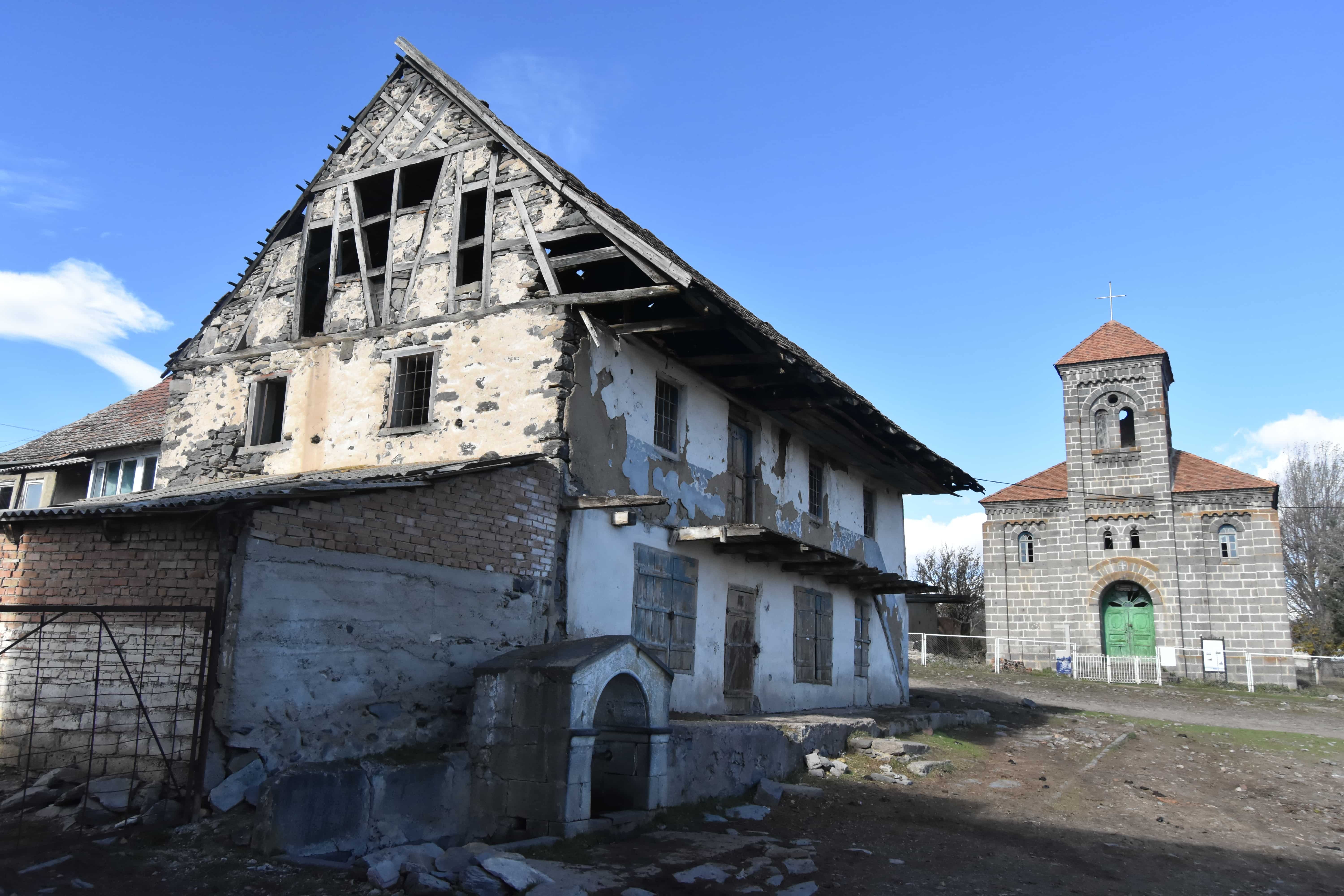
The Germans who settled in Georgia came from Swabia, so, when discussing their architecture, it is important to consider the characteristics of Swabian peasant houses. However, it can be confidently stated that the buildings here bear little resemblance to those found in their homeland, such as those of the Black Forest or Allgäu regions. What the Swabians brought directly from their native region were deep cellars for storing harvests, high attics, window shutters, homestead fences adorned with massive stone pillars, and timber framing (Fachwerk) – an artistic and structural form widespread in traditional European architecture.
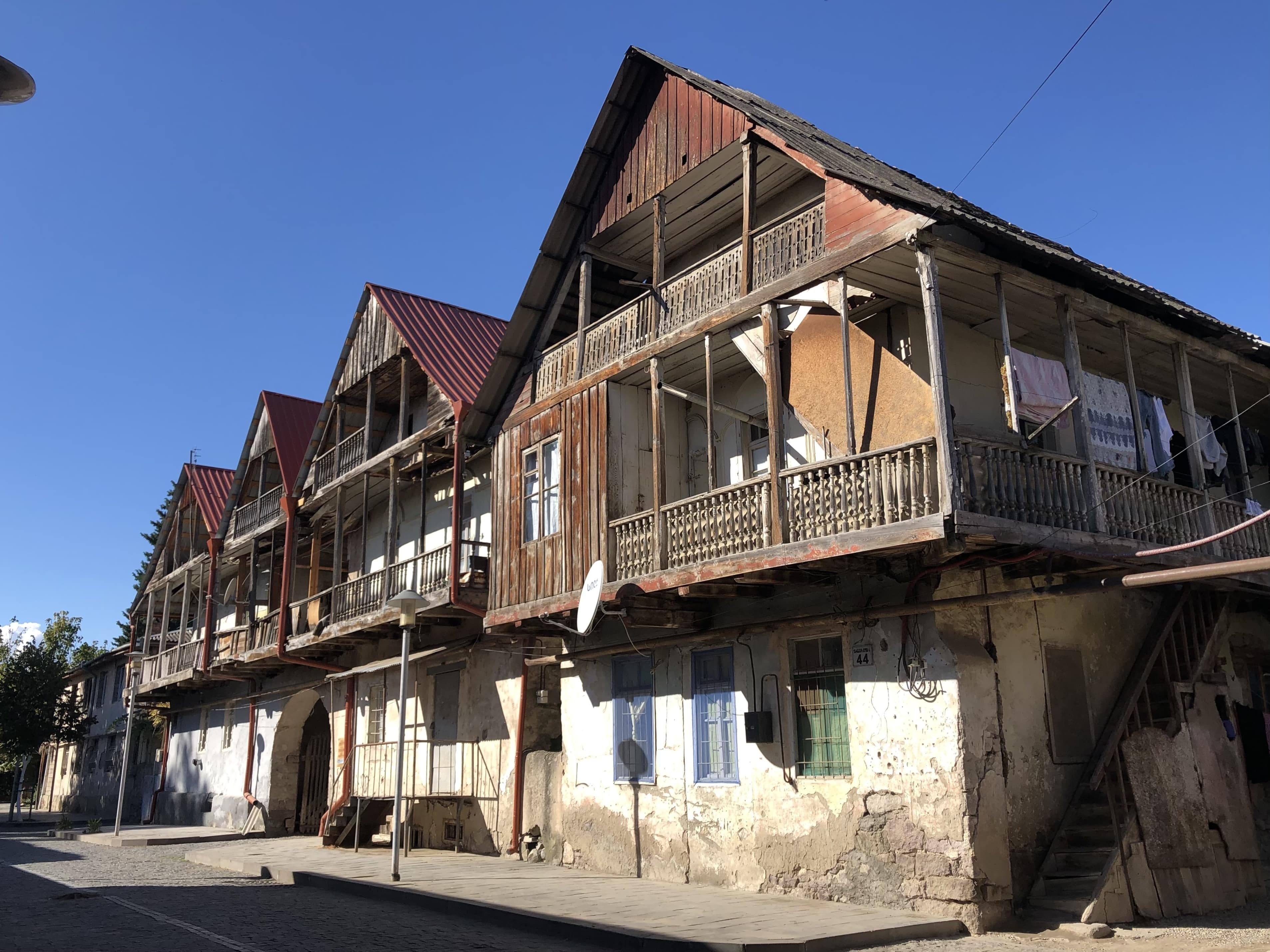
Over time, the size, layout, and façades of German houses evolved. From the second half of the 19th century, Swabian
settlers began richly
decorating the street-facing façades of their homes with balconies featuring colorful wooden
railings. Similar balconies were added to the courtyard sides
of the houses. While
the influence of traditional Georgian architecture is
undeniable, these designs also appear to have been inspired by the iconic wooden balconies of Old
Tbilisi. This was not simply a mechanical imitation of
foreign architectural elements, but a conscious and voluntary adaptation of
local influences.
In
this way, Georgian
architecture breathed new life into the Swabians’ centuries-old vernacular traditions, giving
rise to a distinctive German-Georgian architectural
synthesis, expressed most visibly in the wooden
balconies of their homes.
The German houses, in turn, also influenced local
architecture. Historical documents note that neighboring villages began
adopting these architectural styles. Indeed, several houses built by Georgians
at the beginning of the 20th century still stand today on Iakob Khutsesi Street
in Bolnisi.
This cultural exchange, which extended across almost every sphere of
life, from agriculture and
cuisine to sports and culture, was
accompanied by a remarkably
harmonious and peaceful coexistence. It
came to an end in 1941, when, on Stalin’s
orders, almost the entire
German population of Georgia was deported. It is interesting to consider how
German vernacular architecture might have developed had the deportation not
taken place. By then, German building
traditions in Georgia had already undergone
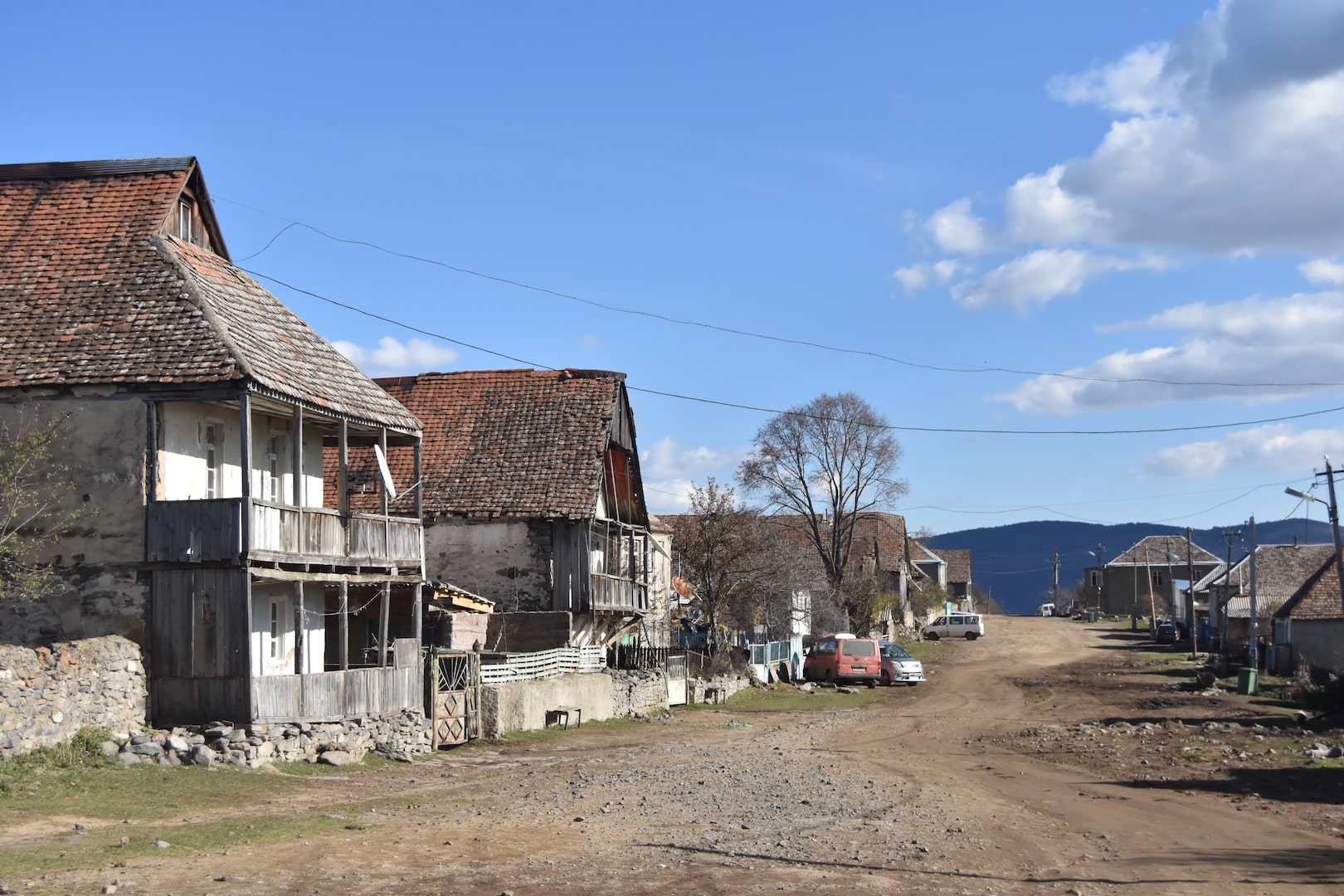
considerable change. A good example is the wine-growing village of Traubenberg,
now Tamarisi in Marneuli Municipality, where almost every house still has the
deep, German-style cellars
traditionally used for winemaking. Yet the facades no longer feature timber
framing (Fachwerk) or the exceptionally high attics characteristic of the
earlier houses. The balconies, meanwhile, have become much wider and
distinctly more Georgian in character.
Since 2015, several German-built structures have been restored, and
significant rehabilitation has been carried out in the historic center of Asureti. Comprehensive projects are
also planned for Bolnisi, which is a welcome development. The architectural
heritage left by our European compatriots is immensely valuable to Georgia’s
history and cultural diversity.